

Working with aluminum projects? You’ve probably struggled with creating strong, durable threads in this soft metal. We understand the challenge! Threaded inserts for aluminum provide permanent, wear-resistant threads that won’t strip or pull out under load, making them ideal for applications that require repeated assembly and disassembly.

These handy fasteners come in various styles and are specifically designed for soft metals like aluminum. The knurled bodies lock tightly into the host material, creating a secure connection that’s much stronger than direct threading. They’re perfect for everything from DIY furniture projects to professional manufacturing applications.
Have you noticed how threaded holes in aluminum tend to wear out over time? That’s where these inserts shine! Made from tougher materials than aluminum, they can withstand multiple screws and unscrews without degrading. We’ve found them particularly useful for reinforcing or repairing tapped holes in aluminum, cast iron, and even magnesium when extra strength is needed.
Types Of Threaded Inserts For Aluminum Applications
Threaded inserts offer reliable fastening solutions when working with aluminum, which is softer than steel. These inserts create strong, durable threads that resist stripping and can withstand repeated assembly and disassembly.
Standard Inserts
Standard threaded inserts for aluminum come in several common varieties. Helical inserts (sometimes called Helicoils) are made from stainless steel wire formed into a spring-like coil. They distribute load evenly and provide excellent thread strength.
Knurled inserts have ridged outer surfaces that bite into the aluminum when pressed in. These create a strong mechanical bond without needing adhesives.
Press-fit inserts are forced into pre-drilled holes and stay in place through friction. Their outer design often includes ribs or knurls for extra grip.
Which type should you choose? It depends on your application’s load requirements and whether you need a permanent or removable solution.
Here’s a quick comparison:
| Insert Type | Installation Method | Strength | Removable? |
|---|---|---|---|
| Helical | Thread-in | High | Yes |
| Knurled | Press-in | Medium-High | No |
| Press-fit | Press-in | Medium | No |
High-Strength Inserts
When your aluminum applications face heavy loads or vibration, high-strength inserts are essential. Key-locking inserts feature external keys that prevent rotation once installed. They’re perfect for applications with high torque requirements.
Self-locking inserts include special features that prevent fasteners from backing out under vibration. These are ideal for equipment that experiences constant movement or shock loads.
We’ve found that expansion inserts work exceptionally well in high-stress applications. These expand when a fastener is installed, creating maximum surface contact with the parent material.
Did you know that some high-strength inserts can increase thread strength by up to 300% compared to direct threading into aluminum? That’s why aerospace and automotive industries rely on them.
For critical applications, consider inserts made from materials like heat-treated steel or bronze for the best combination of strength and corrosion resistance.
Mini Inserts
Mini threaded inserts are designed for smaller aluminum components where space and weight are concerns. These tiny but mighty fasteners typically range from M2 to M5 (or #2 to #10 in imperial sizes).
Ultrathin-wall inserts take up minimal space while still providing reliable threads. They’re perfect for thin aluminum sheets and compact electronic enclosures.
Blind hole mini inserts don’t require through-holes, making them ideal for sealed enclosures or applications where the back side is inaccessible.
We’ve seen great results using micro-knurled inserts in small consumer electronics. Their tiny size doesn’t compromise strength—many can withstand forces similar to their larger counterparts.
When working with mini inserts, precision is key:
- Use the exact drill size recommended by the manufacturer
- Ensure proper depth for complete insertion
- Consider specialized installation tools designed for small sizes
Metric Vs. Imperial Options
Choosing between metric and imperial threaded inserts depends on your project specifications and regional standards. Metric sizes typically range from M3 to M12 and are common in European and Asian manufacturing.
Imperial sizes (indicated by #4, #6, etc. or fractions) remain standard in North American industries. Most suppliers offer both options, but availability may vary by region.
What’s the difference in performance? Very little! Both standards provide excellent strength when properly sized and installed.
Key considerations when choosing:
- Compatibility with existing fasteners
- Tools available for installation
- Regional standards your product will meet
- Replacement part availability
Many manufacturers now produce dual-compatible inserts that work with both metric and imperial fasteners. These universal options simplify inventory management if you work across different measurement standards.
Remember to check thread pitch carefully! Metric and imperial systems use different thread pitch measurements that aren’t directly interchangeable.
Material Selection Guide
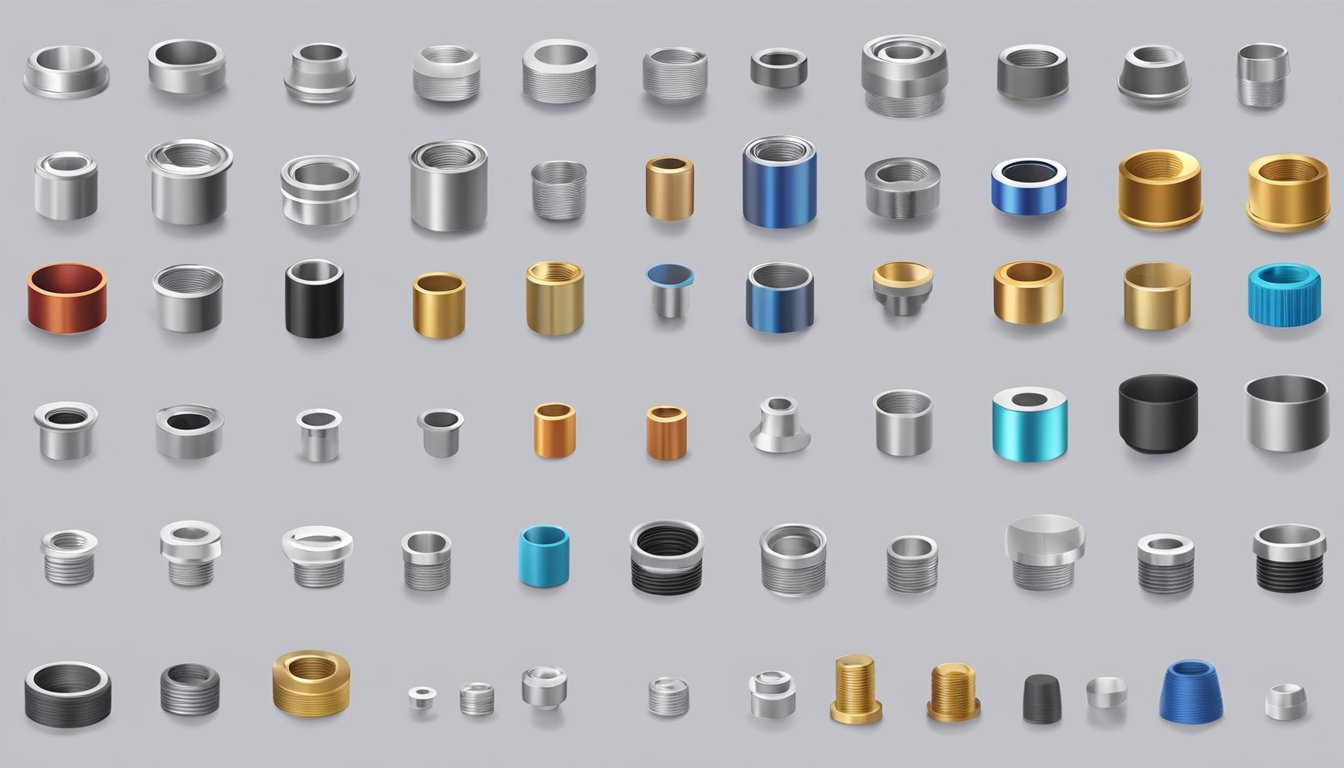
Choosing the right material for threaded inserts in aluminum applications can significantly impact performance, durability, and compatibility. Different materials offer unique advantages depending on your specific requirements and environmental conditions.
Stainless Steel Options
Stainless steel inserts are popular choices for aluminum applications due to their excellent corrosion resistance and strength. We recommend 303 and 304 stainless steel for general applications, while 316 stainless offers superior resistance in saltwater environments.
Key advantages of stainless steel inserts:
- Excellent thread strength (typically 80,000-150,000 PSI)
- Superior corrosion resistance
- Good temperature stability (up to 800°F)
- Long service life
For high-load applications, we’ve found that heat-treated stainless steel inserts can provide up to 30% more pullout strength compared to standard options. These work particularly well in structural aluminum components where safety is critical.
Nickel-Plated Brass Considerations
Brass inserts with nickel plating offer an excellent balance of cost-effectiveness and performance for aluminum applications. The brass core provides good electrical conductivity, while the nickel coating helps prevent galvanic corrosion.
When to choose nickel-plated brass:
- Moderate load applications
- Electrical conductivity requirements
- Cost-sensitive projects
- Indoor or light outdoor exposure
We’ve seen great results using these in electronics housings and consumer products. The nickel plating typically adds 0.0002″-0.0005″ to the overall dimension, which should be accounted for in precision applications.
Brass inserts also tap more easily into aluminum, making them ideal for production environments where installation speed matters.
Titanium Inserts For High-Performance
When exceptional strength-to-weight ratio and corrosion resistance are essential, titanium inserts offer unmatched performance. Though more expensive, these inserts excel in aerospace, marine, and high-end applications.
Performance highlights:
- 40-45% lighter than steel alternatives
- Excellent fatigue resistance
- Superior corrosion protection
- Temperature tolerance from -330°F to 800°F
We’ve found titanium inserts particularly valuable in weight-critical applications. For example, in aerospace components, the weight savings can justify the 3-5x cost premium over stainless steel options.
Titanium’s biocompatibility also makes these inserts ideal for medical devices or equipment where aluminum parts might contact biological materials.
Material Compatibility And Preventing Galvanic Corrosion
When working with aluminum, preventing galvanic corrosion is crucial. This electrochemical process occurs when dissimilar metals contact in the presence of an electrolyte (like moisture).
Galvanic compatibility ranking (best to worst for aluminum):
- Zinc or zinc-plated steel (minimal corrosion risk)
- Nickel-plated brass (low risk)
- Stainless steel (moderate risk)
- Carbon steel (high risk)
- Copper/brass without plating (very high risk)
To prevent galvanic corrosion in your aluminum applications, we recommend:
- Using anodized coatings on the aluminum
- Selecting inserts with protective platings
- Applying dielectric grease during installation
- Considering environmental exposure conditions
For outdoor applications, we strongly suggest using either stainless steel or properly plated inserts combined with appropriate sealants to prevent moisture infiltration at the interface.
Step-By-Step Installation Process

Installing threaded inserts in aluminum requires precision and the right technique. The process involves several key stages from preparation to final installation, with special considerations for this softer metal to ensure strong, lasting threads.
Pre-Installation Preparation
Before you start installing threaded inserts in aluminum, proper preparation is essential. First, you’ll need to gather the right tools:
- Drill and appropriate-sized drill bits
- Tap set compatible with your insert size
- Cutting fluid or lubricant
- Installation tool (often provided with inserts)
- Deburring tool
- Clean cloth for wiping surfaces
Selecting the right insert is crucial. For aluminum applications, we recommend solid-wall inserts or helicoils designed specifically for softer metals.
Always check the manufacturer’s specifications for the exact drill size needed. This typically differs from standard thread sizes because you need to account for the insert’s outer threading.
Clean your work area to prevent debris from interfering with the installation. Mark your drilling location precisely using a center punch to ensure accuracy.
Drilling Techniques For Aluminum
Aluminum requires specific drilling approaches for best results. When drilling aluminum, use sharp, high-quality drill bits preferably designed for non-ferrous metals.
Start with a slower speed to prevent the bit from “grabbing” the aluminum. A good rule of thumb is to use about half the speed you would use for steel. Apply steady, moderate pressure—too much can deform the softer aluminum.
We recommend using a cutting fluid or lubricant specifically formulated for aluminum. This helps:
- Reduce heat buildup
- Prevent chips from sticking to the bit
- Create cleaner holes with smoother walls
Make sure to drill straight down to create a properly aligned hole. Check your progress frequently and clear aluminum chips regularly to prevent clogging.
After drilling, carefully deburr both sides of the hole to remove any sharp edges that could interfere with threading or cause the insert to sit improperly.
Proper Tapping Methods
Tapping aluminum requires finesse to create clean threads without damaging the material. Select a tap that matches the outer thread size specified for your insert. For aluminum, we recommend using spiral point “gun” taps or spiral flute taps.
Start slowly and maintain alignment. Use cutting fluid liberally throughout the process. This is crucial for aluminum as it helps:
- Improve thread quality
- Extend tap life
- Make the tapping process smoother
Turn the tap forward about 3/4 turn, then back 1/4 turn to break chips. This “backing off” technique prevents chip buildup and reduces the chance of tap breakage.
Don’t force the tap—let the cutting edges do the work. If you feel significant resistance, back out completely, clear chips, add more lubricant, and start again.
After tapping, clean the threads thoroughly to remove all metal particles and cutting fluid residue.
Insert Installation Procedure
With your hole properly drilled and tapped, you’re ready to install the threaded insert. For E-Z LOK style solid-wall inserts:
- Thread the insert onto the installation tool or bolt provided in the kit
- Apply a small amount of thread locker to the outer threads if needed for permanent installation
- Align the insert perfectly straight with the tapped hole
- Turn clockwise with steady pressure to start the threads
Using a drill with a socket attachment can make installation easier, but be sure to set it at low speed. Drive the insert slowly until it’s flush with or slightly below the surface.
For helicoil-style inserts, use the specialized installation tool. Insert the coil into the tool, position it at the hole entrance, and push while turning clockwise until properly seated.
Always follow the specific instructions provided by the insert manufacturer, as installation techniques may vary by product type.
Torque Specifications And Avoiding Over-Tightening
Aluminum’s softer nature makes proper torque control essential when using threaded inserts. Over-tightening can strip the threads or damage both the insert and surrounding material.
Consult the manufacturer’s specifications for recommended torque values. If unavailable, use these general guidelines:
| Thread Size | Recommended Torque (in-lbs) |
|---|---|
| M2 / #2 | 2-3 |
| M3 / #4 | 4-6 |
| M4 / #8 | 8-10 |
| M5 / #10 | 18-20 |
| M6 / 1/4″ | 30-35 |
When installing fasteners into the insert, use a torque screwdriver or wrench whenever possible. This provides consistent, measurable force.
Watch for signs of over-tightening such as unusual resistance or deformation of materials. If you feel the fastener “give way,” you’ve likely damaged the threads.
For critical applications, consider testing your installation on scrap material first. This helps you get a feel for the proper torque before working on your actual project.
Industry-Specific Applications
Threaded inserts for aluminum have become essential components across various industries due to their ability to create strong, durable connections in soft metals. Different sectors have developed specialized requirements and standards for these fastening solutions based on their unique operating conditions.
Aerospace Applications And Standards
Aerospace engineers rely heavily on threaded inserts when working with aluminum components. Weight reduction is critical in aircraft design, and aluminum’s lightweight properties make it ideal – but its threading needs reinforcement.
Key aerospace standards include:
- AS8879 for helical wire inserts
- NAS1130 for solid bushing inserts
- MS51830 for thin-wall inserts
We’ve seen these inserts used in control panels, instrument housings, and structural connections where vibration resistance is crucial. In high-stress areas like engine mounts, special high-temperature threaded inserts combine stainless steel with proprietary coatings.
For example, the Boeing 787 Dreamliner uses thousands of specialized aluminum threaded inserts in its construction, allowing frequent maintenance access without thread wear concerns.
Automotive Use Cases
In automotive manufacturing, threaded inserts solve many challenges when working with aluminum engine blocks, transmission housings, and body panels. They provide the thread strength needed for components that require regular maintenance or replacement.
Common automotive applications include:
- Engine cylinder heads (oil drain plugs)
- Transmission casings
- Intake manifolds
- Aluminum wheel assemblies
European automakers often use M6 and M8 thread inserts in dashboard assemblies. We’ve found that phosphor bronze inserts work particularly well for automotive electrical components due to their conductivity and corrosion resistance.
Many manufacturers prefer press-fit threaded inserts for high-volume production lines as they install quickly and don’t require special tooling during final assembly.
Electronics And Precision Requirements
The electronics industry demands extremely precise threading solutions for aluminum housings and heat sinks. Miniaturization trends have pushed manufacturers toward smaller thread profiles with tighter tolerances.
Thread inserts in this sector typically feature:
- Fine pitch threads (0.5mm-0.75mm)
- Precision machined surfaces
- Non-magnetic properties
- Thermal expansion compatibility
We’ve observed electronics manufacturers using self-tapping inserts in server racks and communication equipment. These applications require excellent electrical continuity between the insert and the aluminum housing.
For consumer electronics like laptops and tablets, micro-threaded inserts (often M2 or smaller) secure components while allowing for disassembly during repairs. Heat-dissipating devices frequently use aluminum with specialized threaded inserts that maintain thermal conductivity.
General Manufacturing Solutions
Across general manufacturing, threaded inserts solve countless aluminum threading challenges from furniture to sporting equipment. The versatility of these components makes them suitable for nearly any application requiring durable threads in aluminum.
Popular manufacturing applications include:
- Furniture assembly hardware
- Exercise equipment frames
- Industrial control panels
- Commercial kitchen equipment
We’ve noticed a trend toward keyed or knurled exterior designs that prevent rotation within softer aluminum. For outdoor applications, many manufacturers choose aluminum-specific inserts with corrosion-resistant coatings.
Production efficiency improves significantly when using self-clinching inserts that can be installed during the stamping process. This eliminates secondary operations and reduces overall manufacturing costs.
Maintenance Best Practices And Troubleshooting

Proper maintenance of threaded inserts in aluminum is crucial for ensuring their longevity and performance. Regular care can prevent common problems and extend the life of your fastening systems.
Regular Inspection Procedures
We recommend checking your threaded inserts every 3-6 months, especially in applications with vibration or load cycles. Look for signs of loosening by gently testing the insert with an appropriate tool.
Visual inspection checklist:
- Look for cracks in the surrounding aluminum
- Check for corrosion or oxidation at insert edges
- Verify the insert remains flush with the surface
- Examine for thread damage or deformation
Run your finger around the edge of the insert to feel for any movement. If you notice slight movement, address it immediately before it worsens.
For industrial applications, use a torque test with 50% of the normal tightening torque to check if inserts maintain proper grip. Document your findings in a maintenance log to track changes over time.
Common Issues And Solutions
Issue: Loose insert Solution: Apply a small amount of medium-strength threadlocker to secure the insert. In severe cases, remove and reinstall with epoxy backing.
Issue: Stripped threads Solution: Replace the insert with a slightly larger size or use a thread repair kit. For valuable components, consider over-drilling and installing a larger diameter insert.
Issue: Corrosion between aluminum and insert Solution: Clean thoroughly with isopropyl alcohol. Apply anti-corrosion compound before reinstallation. Consider switching to stainless steel or coated inserts for humid environments.
Sometimes inserts spin during fastener removal. To prevent this, use a backing tool during initial installation or apply appropriate adhesive to the insert’s outer surface.
For misaligned inserts, use guide tools during reinstallation to ensure proper orientation.
Removal Techniques
Have you ever struggled with removing damaged inserts? We’ve developed some effective techniques to make the process easier.
For accessible inserts:
- Use a specialized extraction tool that grips the inner threads
- Apply penetrating oil around the insert edges
- Wait 10-15 minutes for the oil to work
- Turn counterclockwise with steady pressure
For stubborn inserts, try using heat. Warm the surrounding aluminum to about 150°F with a heat gun. This causes the aluminum to expand slightly more than the insert, making removal easier.
As a last resort, you can drill out the insert using a bit slightly smaller than the insert’s outer diameter. Work slowly and carefully to avoid damaging the surrounding material.
Repair Options For Damaged Inserts
When dealing with damaged threads, we have several reliable repair options. For minor damage, a thread chaser or tap can restore the threading without replacement.
For more serious damage, these methods work well:
Method 1: Oversizing Install a larger diameter insert in the same location after drilling out the damaged one. This works when there’s sufficient material around the hole.
Method 2: Epoxy reinforcement Mix high-strength epoxy designed for metal bonding. Apply it to the outer surface of a new insert, then install it in the prepared hole. This adds significant strength to the connection.
Method 3: Thread repair kits Commercial kits like Helicoil and E-Z LOK work wonderfully for aluminum repairs. They create new, reinforced threads that are often stronger than the original aluminum threads.
For critical applications, consider sending the component to a professional machine shop that specializes in thread repair.
Selection Guide: Choosing The Right Insert

Selecting the appropriate threaded insert for your aluminum project requires careful consideration of multiple factors to ensure optimal performance. The right choice depends on your specific needs and the demands of your application.
Size Considerations And Reference Chart
When selecting threaded inserts for aluminum, size is critical. You’ll need to match both the external diameter (what fits into your material) and the internal thread (what your fastener will thread into).
Standard Threaded Insert Sizing Chart:
| Insert Type | Common Sizes (Internal) | Typical External Diameter | Recommended Hole Size |
|---|---|---|---|
| Helicoil | #8-32, 10-24, 1/4-20, 5/16-18 | 1.5× thread diameter | Drill size + 0.015″ |
| Press-fit | M3, M4, M5, M6, 1/4-20 | 2× thread diameter | Insert OD – 0.005″ |
| Self-tapping | #6-32 to 3/8-16 | 1.25× thread diameter | 85-90% of insert OD |
We recommend sizing up one thread size from what you’d use in steel. For instance, if you’d use a #8 screw in steel, consider a #10 insert for aluminum to compensate for aluminum’s lower strength.
Always check manufacturer specifications for the exact drill size needed for your specific insert.
Load Requirements Assessment
Understanding the forces your threaded insert will face is essential for making the right selection. Different inserts offer varying levels of pullout and torque resistance.
Key load factors to consider:
- Tensile loads (pulling forces) typically require longer inserts
- Shear loads (sideways forces) need inserts with wider flanges
- Torque loads benefit from inserts with knurled or textured exteriors
For heavy-duty applications, key-locked inserts like Keenserts or ring-locked inserts like Rosans offer superior strength compared to standard helical inserts. These provide approximately 25-30% greater pullout resistance and can handle repeated assembly/disassembly cycles.
We’ve found that inserts with wider diameters improve overall torque-out capacity, while longer inserts enhance pullout capacity. For critical applications, perform load testing with your specific material and insert combination.
Environmental Factors
The environment where your threaded insert will function significantly impacts which type you should choose. Aluminum’s properties mean environmental considerations are especially important.
Temperature variations: Choose inserts that have similar thermal expansion properties to aluminum if your application will experience temperature fluctuations. Stainless steel inserts often work well here.
Corrosion concerns: When exposed to moisture or chemicals, galvanic corrosion between dissimilar metals can occur. For outdoor or marine applications, we recommend:
- Coated steel inserts
- Stainless steel inserts (300 series)
- Aluminum inserts for maximum compatibility
Vibration resistance: Applications with continuous vibration benefit from thread-locking features or inserts with mechanical locking mechanisms. Self-locking inserts can maintain torque even under sustained vibration.
Remember that aluminum’s softness means inserts can work loose over time in high-vibration environments unless properly selected and installed.
Cost Vs. Performance Analysis
Balancing cost and performance is crucial when selecting threaded inserts for aluminum projects. While premium options offer advantages, they aren’t always necessary.
Budget-friendly options like helical coil inserts provide good performance for light-duty applications at around $0.15-$0.50 per insert. These work well for occasional use and non-critical applications.
Mid-range solutions include press-fit and molded-in inserts ($0.50-$2.00 each), offering better reliability for moderate-load applications without significant cost increases.
Premium inserts such as key-locked styles ($3-$7 each) deliver superior performance but at higher cost. These are justified for:
- Safety-critical applications
- High-load scenarios
- Applications requiring frequent assembly/disassembly
We’ve found that investing in quality inserts initially often saves money long-term by preventing failures and rework. For production environments, calculate the total cost including installation time – some more expensive inserts install much faster, offsetting their higher unit cost.
Expert Tips And Best Practices

Working with threaded inserts for aluminum requires attention to detail and proper technique. These insights from professionals will help you achieve strong, lasting connections while avoiding common pitfalls.
Professional Insights
When installing threaded inserts in aluminum, always remember that proper hole sizing is critical. We’ve found that holes should be drilled about 0.5mm larger than the insert’s outer diameter for optimal results.
Pre-tapping the pilot hole can make a huge difference in the quality of your installation. This creates cleaner threads and reduces the risk of damaging the soft aluminum material.
Temperature matters! For heat-set inserts, maintaining consistent heat is crucial. Too hot, and you’ll melt excess aluminum; too cold, and the insert won’t seat properly. We recommend using a temperature-controlled soldering station set between 600-650°F for most applications.
Consider using thread-locking compounds for applications subject to vibration. A small drop of medium-strength thread locker can prevent inserts from backing out over time.
Common Mistakes To Avoid
Using the wrong size drill bit is one of the biggest errors we see. Always verify the manufacturer’s specifications before drilling your pilot hole.
Never force an insert! If you’re meeting resistance during installation, stop and reassess. Forcing can lead to stripped threads or cracked aluminum.
Skipping deburring is another common mistake. Sharp edges around the hole can interfere with proper seating and may cause the insert to sit at an angle.
We often see people overlooking material thickness. The aluminum should be at least 1.5 times thicker than the length of your insert for adequate strength.
Don’t rush the cooling process with heat-set inserts. Allow them to cool naturally for the strongest bond. Quenching with water can create weak spots in the connection.
Tools That Make Installation Easier
A dedicated insert installation tool is worth the investment. These tools provide better control and consistent results compared to makeshift methods.
Must-have tools include:
- Variable-speed drill press for creating precise pilot holes
- Thread tapping set with cutting fluid
- Digital caliper for accurate measurements
- Installation mandrels specific to your insert size
For heat-set inserts, a temperature-controlled soldering iron with specialized tips makes a world of difference. We prefer models with digital readouts for precise temperature control.
A bench vice with soft jaws helps hold work pieces steady during installation. This prevents the aluminum from shifting while you’re working.
Consider investing in a thread depth gauge to ensure consistency across multiple installations.
Special Techniques For Challenging Applications
For thin aluminum sheets (under 3mm), try the sandwich method. Place a backing plate behind the workpiece during installation to prevent distortion and provide additional support.
When working with curved surfaces, create a small flat spot with a countersink bit before drilling your pilot hole. This prevents the drill from walking across the surface.
For blind holes in thick aluminum:
- Drill deeper than needed
- Blow out all chips and debris
- Apply a small amount of epoxy to the bottom of the hole
- Install the insert
In high-vibration environments, we’ve had success using knurled inserts that provide additional grip. Combine these with a medium-strength thread locker for maximum holding power.
For structural applications, consider using larger diameter inserts than technically required. This provides a safety margin and extends the service life of the connection.


