

Looking for the right tools to tackle stainless steel machining projects? Roughing end mills are your best friends when you need to remove large amounts of material quickly. High-performance roughing end mills designed specifically for stainless steel can provide precision cuts while maintaining durability throughout the cutting process.

When we work with stainless steel, we need cutters that can handle the material’s toughness and tendency to work-harden. Roughing end mills (also called ripping cutters or hoggers) are built differently than standard end mills, with special tooth geometries that break chips into smaller pieces and reduce cutting forces. This design helps us avoid the common headaches of stainless steel milling like excessive tool wear and poor surface finish.
We’ve found that solid carbide roughing end mills from manufacturers like Kennametal and former ATI Stellram (now owned by Kennametal) perform exceptionally well on stainless steel workpieces. These cutters allow us to maximize material removal rates while extending tool life – a win-win for productivity and your budget. With the right roughing strategy, you’ll prepare your parts for finishing operations more efficiently than ever before.
Selecting The Optimal Tool Material And Coating
Choosing the right tool material and coating is crucial for successful stainless steel roughing operations. The proper combination will significantly impact tool life, cutting efficiency, and surface finish quality.
Why Solid Carbide Is The Industry Standard
Solid carbide end mills have become the go-to choice for machining stainless steel. Why? They offer exceptional hardness and heat resistance compared to other materials. When roughing stainless steel, you need tools that can withstand the heat and stress.
Carbide end mills maintain their cutting edge longer, even under the challenging conditions stainless steel presents. This means fewer tool changes and more consistent results throughout your machining process.
We’ve found that solid carbide provides the best balance of:
- Toughness to resist chipping
- Hardness to maintain edge sharpness
- Thermal stability to handle the heat generated
Most professional machinists we’ve worked with prefer carbide end mills with 10% cobalt content for roughing stainless steel. This composition provides excellent wear resistance without becoming too brittle.
Comparison With Alternative Materials
While solid carbide dominates the market, other materials do have specific applications. High-Speed Steel (HSS) end mills are more affordable but wear down quickly in stainless steel applications. They’re best saved for occasional or light-duty work.
Comparison Table: Tool Materials for Stainless Steel
| Material | Cost | Tool Life | Heat Resistance | Best Use Case |
|---|---|---|---|---|
| Solid Carbide | High | Excellent | Excellent | Professional production |
| HSS | Low | Poor | Fair | Occasional use |
| HSSE (w/Vanadium) | Medium | Good | Good | Medium production |
HSSE (High-Speed Steel with Vanadium) offers a middle ground. These tools have better wear resistance than standard HSS and are suitable for aluminum and some stainless steel work. They cost less than carbide but don’t last as long.
For serious production work with stainless steel, the investment in solid carbide tools pays off through extended tool life and better performance.
Specialized Coatings And Their Benefits For Stainless Steel
The right coating can dramatically improve an end mill’s performance in stainless steel. TiAlN coating (Titanium Aluminum Nitride) is our top recommendation for stainless steel roughing operations.
TiAlN coated carbide end mills offer:
- Superior heat resistance (up to 800°C)
- Reduced friction between the tool and workpiece
- Increased hardness that improves with heat
This coating forms a thin aluminum oxide layer during cutting that acts as a thermal barrier, helping to direct heat into the chips rather than the tool.
Another excellent option is AlTiN coating, which provides similar benefits with slightly different characteristics. For extremely demanding applications, we sometimes recommend multi-layer coatings that combine the benefits of different materials.
When selecting your coating, consider your specific operation. Are you doing heavy roughing? A thicker TiAlN coat might be best. Working with specialized stainless alloys? A nano-composite coating could provide the edge you need.
Critical Design Features For Stainless Steel Roughing
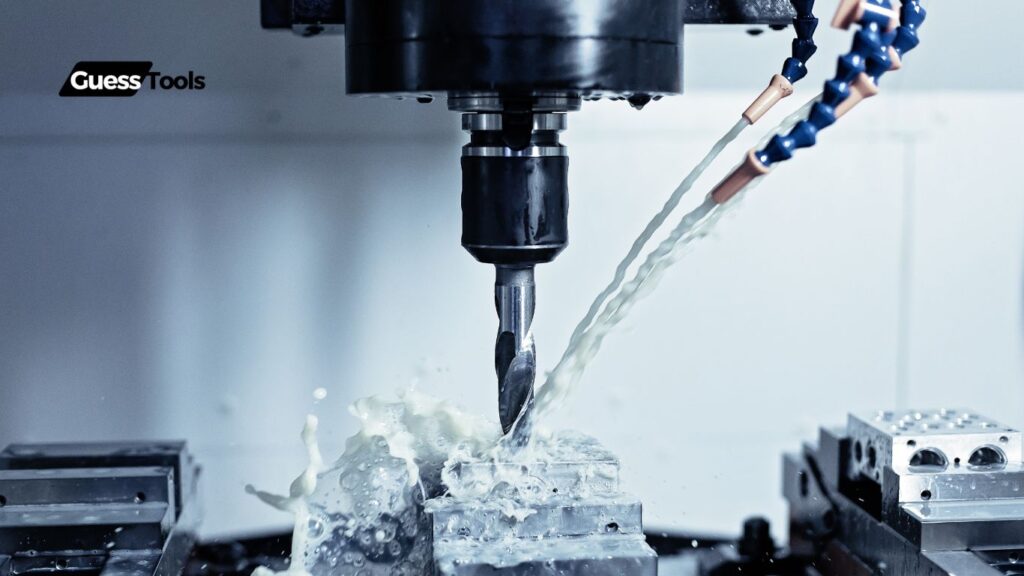
Selecting the right roughing end mill for stainless steel requires understanding specific design elements that impact performance. These features can dramatically improve your cutting efficiency while extending tool life when working with this challenging material.
Flute Count Considerations
When roughing stainless steel, the number of flutes on your end mill matters significantly. 4-5 flutes is typically ideal for most stainless steel roughing operations. Why? Let’s break it down:
- 4 flutes: Provides good chip evacuation with moderate feed rates
- 5 flutes: Allows higher feed rates while maintaining stability
- 3 flutes: Better for deeper cuts where chip clearance is critical
We’ve found that 5-flute tools generally offer the best balance for roughing applications in stainless steel. They remove material quickly while distributing cutting forces evenly. This reduces the heat buildup that’s so problematic when machining stainless.
Remember that fewer flutes create larger chip pockets, which helps prevent chip recutting—a common issue when roughing stainless steel.
Specialized Designs
Roughing end mills for stainless steel feature unique design elements that distinguish them from standard tools:
Serrated cutting edges are perhaps the most visible difference. These “teeth” break chips into smaller, manageable pieces that evacuate more easily from the cutting zone.
High helix angles (usually 35-45 degrees) help lift chips away from the workpiece surface. This design feature is crucial for stainless steel, which produces stubborn, stringy chips that can cause tool failure.
Variable pitch patterns between flutes reduce harmonic vibration, which is especially important when roughing stainless steel at high material removal rates.
Robust core thickness provides the strength needed to withstand the cutting forces encountered in stainless steel.
How These Features Address Stainless Steel’s Specific Challenges
Stainless steel presents unique machining difficulties that specific roughing end mill designs help overcome:
Work hardening resistance: The serrated edges and variable pitch design minimize the work hardening effect by maintaining consistent cutting forces and reducing vibration.
Heat management: Multiple flutes distribute heat across more cutting edges, while proper chip evacuation prevents heat buildup. This addresses stainless steel’s poor thermal conductivity.
Chip control: The combination of serrated edges and high helix angles transforms those problematic stringy chips into smaller, manageable fragments that clear the cutting zone efficiently.
Tool wear reduction: Specialized coatings like AlTiN or TiCN provide a protective barrier against the abrasive nature of stainless steel, extending tool life by up to 50% in rigorous applications.
By selecting roughing end mills with these design features, we can significantly improve our machining efficiency and tool life when working with stainless steel.
Optimizing Machine Parameters For Maximum Performance
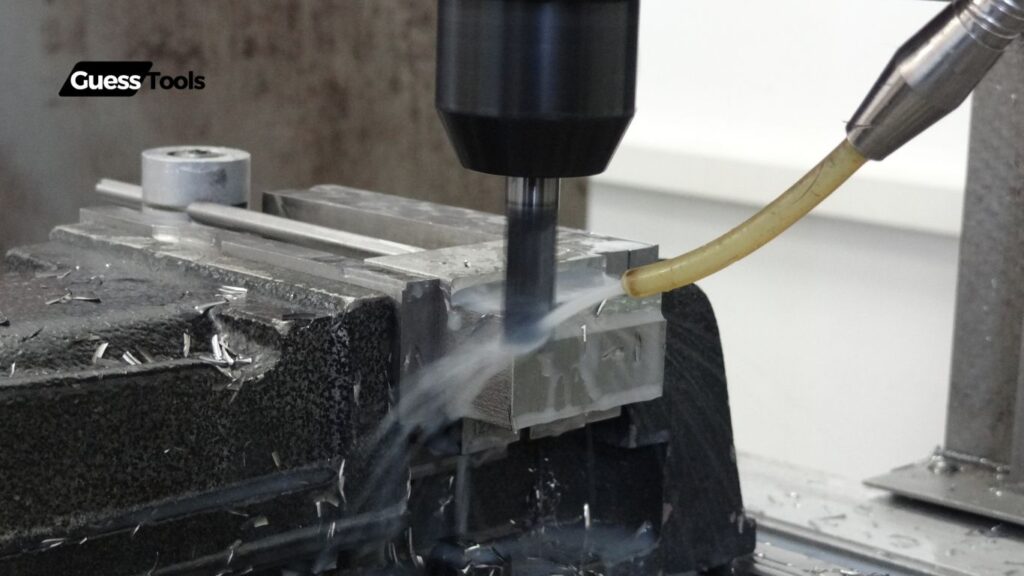
Getting the most out of your roughing end mill when working with stainless steel requires careful attention to machine parameters. The right settings can dramatically improve tool life, cutting efficiency, and surface finish quality.
Recommended Speeds And Feeds
When machining stainless steel, finding the sweet spot for speeds and feeds is crucial for success. Search results indicate that a surface feet per minute (SFM) between 100-350 is generally recommended for stainless steel.
For roughing operations, we suggest starting with these parameters:
- Chip load: Between 0.0005″ for 1/8″ tools up to 0.003″ for larger diameter tools
- Cutting speed: Lower end of the range (100-150 SFM) for tougher grades
- Feed rate: Calculated based on RPM × number of flutes × chip load
For roughing operations, 5-9 flute end mills work best. Fewer flutes provide more chip space, allowing for larger step-overs and more aggressive material removal.
Are you getting chatter? Try reducing your speed by 10-15% while maintaining feed rate.
Coolant Considerations
Proper cooling is non-negotiable when roughing stainless steel due to its poor thermal conductivity and work-hardening tendencies.
Best cooling practices:
- High-pressure coolant directed at the cutting edge helps break chips and reduce heat
- Flood cooling works well for general roughing operations
- Through-tool coolant is ideal for deeper pockets and holes
We’ve found that a 10% concentration of synthetic coolant provides excellent results. This helps prevent built-up edge on the tool and reduces thermal shock.
Never run stainless dry! The heat generated will dramatically shorten tool life and potentially work-harden the material, making subsequent cuts more difficult.
Parameter Adjustments Based On Different Stainless Steel Grades
Not all stainless steel behaves the same way. Different grades require specific parameter adjustments for optimal machining.
| Grade | Recommended SFM | Chip Load Adjustment | Notes |
|---|---|---|---|
| 304/304L | 100-200 | Standard | Most common, moderately difficult |
| 316/316L | 90-180 | Reduce by 10-15% | More gummy, reduce speed |
| 410/420 | 120-250 | Increase by 10% | Hardened types need slower speeds |
| 17-4 PH | 80-160 | Reduce by 20% | Very tough, use rigid setup |
For austenitic grades (300 series), we recommend a more conservative approach with lower speeds. These grades work-harden quickly.
For martensitic grades (400 series), slightly higher speeds can be used, but watch for tool wear carefully.
What about duplex stainless? These are the toughest to machine – reduce your speeds by 25% from what you’d use for 304.
Common Challenges And Troubleshooting

Working with stainless steel using roughing end mills presents several common issues that can impact your machining results. Let’s explore how to overcome these challenges and keep your operations running smoothly.
Preventing Tool Breakage And Premature Wear
Tool wear is one of the biggest headaches when roughing stainless steel. We’ve found that incorrect cutting speeds are often the culprit. When your RPM is too high, the tool overheats quickly, especially without proper coolant.
Key prevention tips:
- Use carbide end mills specifically designed for stainless steel
- Reduce cutting speeds to 250-300 SFPM for 304 stainless (lower than aluminum)
- Apply abundant coolant to manage heat buildup
- Start with a 0.001″-0.002″ chip load and adjust based on results
Don’t ignore tool coatings! AlTiN and TiCN coatings significantly extend tool life in stainless applications. We’ve seen tool life improvements of 30-40% with proper coatings.
Regular inspection between cuts helps catch early signs of wear before catastrophic failure occurs.
Managing Work Hardening Issues
Stainless steel loves to work harden, which can quickly destroy your end mill. This happens when you use light cuts or dwell too long in one spot.
Effective strategies include:
- Maintain consistent chip loads (never less than 0.001″ per tooth)
- Use climb milling instead of conventional milling when possible
- Keep the tool continuously engaged in the material
- Avoid dwelling or rubbing the tool against the workpiece
We recommend using roughing end mills with variable flute spacing, which helps break up harmonics and reduces chatter. This is especially important in deep pockets.
A good rule of thumb: if you see discoloration on your chips or smell burning metal, you’re probably work hardening the material.
Problem-Solving Guide For Typical Roughing Operations
When your roughing end mill clogs or burns out during stainless steel operations, try these proven solutions:
For clogging issues:
- Switch to a lower flute count (3-4 flutes for roughing rather than 7)
- Increase chip clearance with a larger flute valley design
- Make sure coolant is directed precisely at the cutting zone
For tool breakage:
- Reduce depth of cut to 30-40% of tool diameter maximum
- Check for machine vibration or weak fixturing
- Consider a more rigid tool holder (shrink fit or hydraulic)
Is your surface finish inconsistent? We often see this when feed rates are too aggressive or worn tools are used beyond their service life. Keep roughing operations between 60-70% of the tool’s rated capacity for best results.
Remember that high-temperature alloys like 304SS need more power at the spindle than standard materials. Underpowered machines will struggle regardless of tool quality.
Best Practices For Tool Management And Maintenance
Proper care of your roughing end mills for stainless steel will significantly extend their lifespan and improve your machining results. We’ve found that implementing a structured approach to tool management saves both time and money in the long run.
Inspection Routines To Maximize Tool Life
Regular inspection is crucial for maintaining your roughing end mills. We recommend checking your tools before and after each use for signs of wear or damage. Look for:
- Dulled cutting edges
- Chipping along the flutes
- Discoloration (indicating heat damage)
- Buildup of material on cutting surfaces
A simple 5x magnifying glass works for quick checks, but a 10-20x microscope is better for detailed inspections. Take photos of new tools as reference points for comparison later.
Set up a weekly inspection schedule for frequently used tools. Record wear patterns in a maintenance log to identify recurring issues. This helps predict tool life and prevent unexpected failures.
Clean tools after inspection using a soft brush and appropriate solvent. Avoid compressed air, which can drive chips deeper into the machine.
Storage And Handling Recommendations
Proper storage prevents premature damage to your expensive carbide end mills. Always store tools in:
- Individual slots or compartments to prevent contact with other tools
- Dry environments with humidity control (40-60% is ideal)
- Original packaging or purpose-designed tool holders
Never toss tools into drawers where they can chip against each other!
When handling tools, we always wear gloves to prevent fingerprints and oils from transferring to the carbide. These residues can cause corrosion or affect performance.
Organize your storage by tool type and size for easy access. Label everything clearly with size, material, and purpose. Consider using color-coding for quick identification.
Keep an inventory system to track tool usage and replacement schedules. This prevents work stoppages due to missing tools.
When To Replace Vs. When To Resharpen
Making smart decisions about replacement versus resharpening saves money without sacrificing quality. Here’s our guidance:
Consider resharpening when:
- The tool shows uniform wear without chipping
- Less than 25% of cutting edge material is worn
- The tool’s coating is still largely intact
- You need the tool quickly and have resharpening capabilities
Replace the tool when:
- Significant chipping or breakage has occurred
- Multiple resharpening has already been done
- The core diameter has been reduced too much
- The cost of resharpening approaches 60-70% of a new tool’s price
Track the number of resharpening cycles for each tool. Most roughing end mills for stainless steel can be resharpened 2-3 times before replacement becomes more economical.
Remember, a freshly resharpened tool may require different speeds and feeds than a new one. Adjust your machining parameters accordingly.
Real-World Performance Data And ROI Considerations
When selecting roughing end mills for stainless steel, understanding performance data and cost implications can dramatically impact your shop’s bottom line. Let’s examine the numbers behind tool selection and how they affect your overall productivity and profitability.
Industrial Statistics On Tool Life And Performance
Most shops report that premium roughing end mills for stainless steel last 2-3 times longer than standard options. Data from several major manufacturers shows an average tool life of 45-60 minutes of cutting time for standard carbide tools in 316 stainless, while premium tools often exceed 120 minutes.
Speed significantly impacts tool life. As one machinist noted in our research, “Take the biggest cut at the highest feed and slowest speed you can.” This approach typically results in a 30-40% increase in tool life.
Temperature management is critical in stainless. Studies show that tools maintaining temperatures below 800°F last approximately 40% longer than those regularly exceeding this threshold.
Shops using specialized stainless steel roughing strategies report:
- 25-35% reduction in overall cycle times
- 50-70% decrease in tool changes
- 15-20% lower cost per part
Cost-Benefit Analysis Of Premium Vs. Standard Tools
Premium roughing end mills typically cost 40-60% more than standard options. However, this increased initial investment often pays dividends through extended tool life and improved performance.
Cost Comparison Example:
| Tool Type | Initial Cost | Parts Per Tool | Cost Per Part |
|---|---|---|---|
| Standard | $45 | 25 | $1.80 |
| Premium | $75 | 65 | $1.15 |
When we factor in reduced machine downtime for tool changes, the ROI becomes even more compelling. A machine with a $100/hour operating cost loses approximately $1,250 annually in tool change time with standard tools versus premium alternatives.
Many shops are now reusing tools strategically. As Seco Product Manager Jay Ball suggests, “Reusing tools for lower tolerance passes is a simple method for increasing overall tool ROI.”
Case Studies Highlighting Successful Applications
An aerospace manufacturer in Seattle switched to Hanita Varimills for roughing 17-4 stainless components. They reported a 65% increase in tool life and were able to increase cutting speeds by 20% while maintaining edge integrity.
A medical device manufacturer tested three different premium roughing end mills on 316L stainless. The winning tool decreased cycle time by 35% and increased parts per tool from 22 to 58, resulting in annual savings of $42,000 across their production line.
An oil and gas component supplier in Texas implemented a high-efficiency roughing strategy with specialized stainless steel end mills. Their results were impressive:
- Tool cost reduction of 23%
- Production increase of 31%
- Annual savings exceeding $75,000
These real-world examples demonstrate that the right roughing strategy and tool selection for stainless steel can transform production efficiency and dramatically improve your shop’s profitability.


